
 519-646-2222
Mortgage Renewals 2026
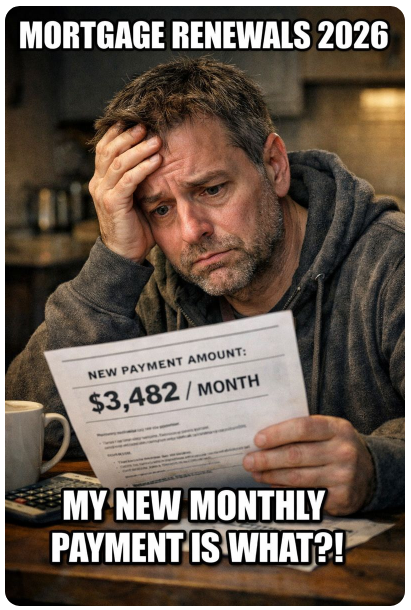
A huge amount of mortgage renewals are about to be signed. It is estimated that between 20%-30% of Canadian mortgagors will be renewing their mortgages in 2026.
Unfortunately for many mortgagors these mortgages relate to grossly overpriced properties that were purchased between 2020 and 2022 at a time when mortgage rates were being supressed to maintain buoyancy in the economy.
What this means is that mortgage payments are expected to rise significantly even though mortgage rates remain at historical lows. This is an especially tough time for such increases amidst falling property prices and rampant inflation.
Official government inflation measures do not calculate all living costs and miss many critical measures. For example, we have seen many grocery costs increase by 40% over a short period of time but these increases are not reflected in official statistics.
Today’s expectations are completely unrealistic on many fronts, not least of all being the sense of entitlement that has beleaguered and bewildered the last two generations. It is always easier to spend money than it is to earn it, and spend they have!
The money that has been spent has been money that simply does not exist – credit card spending has reached such astronomical levels that it is unlikely Canadians will ever be able to repay their balances. More money is charged annually on credit cards than is being earned in after tax income.
Lenders are dealing with more defaulted mortgages than they have seen in years, and the numbers are going up. In the USA and the UK, a mortgage is in default after one missed payment. In Canada, the definition is much more liberal – a mortgage is only in default after at least 90 days of missed payments and not even then if the lender has entered into a forbearance arrangement.
Nonetheless, the TREB (Toronto Real Estate Board) has reported that powers of sale and foreclosures have increased by some 3,500% in the past four years. Those numbers are based on MLS listing reports, lenders are holding back on releasing properties to markets in an effort to preserve recoveries.
Although a hard pill to swallow for the speculators and borrowers who drove up real estate prices and overextended themselves on credit, the best thing they could do (for the economy) is walk away and allow the market to properly correct.
Now, is not the time, even with historically low interest rates, to take on more debt. We have said it in previous years, “when interest rates are low – that is not the time to borrow, that is the time to repay your debts.” If you missed that opportunity, digging in now and paying more than you can really afford is not realistic – it is a path that will inevitably lead to even more debt problems in the future.