
 519-646-2222
There is no such thing as “leverage”
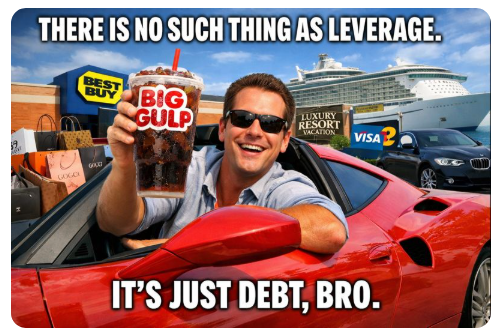
There is no such thing as “leverage” – the term leverage is used by lenders to dupe you into taking on more debt. You cannot use debt to create wealth, you cannot use debt to get out of debt, when you use debt you are being leveraged, your wealth, such as it is, is being drained by the lender(s).
Let’s consider the most obvious debt trap that so many have fallen for – leveraging your RRSP to buy a house!
This is one of the most ridiculous abuses of the middle class – many people don’t have RRSPs, but they are made aware of the possibility of “leveraging” an RRSP by bankers. Buying a house is the basic dream/promise sold to the middle class – the notion of stepping up and staking out your own piece of the country, becoming a Baron (landowner) instead of a Serf.
It’s easy to sell debt, most people don’t know why they want it, but they all want it!
Think about your life goals, go to school, make friends, become a part of the community, get an education, start a career, meet your life partner, buy a house, have kids, buy a nice car, go on vacation, enjoy your hobbies… No where in there is “go into debt” or file a “bankruptcy” or for that matter “help other people” or “create something remarkable” – the dream is all about self-indulgence, that what we have been taught “defines success” – and everyone wants to succeed, right?
You have been indoctrinated to trust institutions, to trust (at least to some extent) politicians, and icons of success – rich people. Hollywood has made piles of movies about people who have risen from nothing to enjoy all the aforementioned trappings of success. This exposure has reinforced in your mind how important such goals are to becoming a “successful” member of society.
When you ask your banker about buying a house, and they tell you that you need a down-payment in order to qualify for a loan – to get your name registered on title of the largest single debt product you will ever have – you eagerly listen.
The Trudeau regime not only encouraged you to overpay for a house, taking out a loan that was three times greater than the value of the asset – you thought you were buying – they also encouraged you take on even more debt. You are the object of leverage by a failing financial system that has been cusping on collapse for decades – saved only by “leveraging” your income.
Under Trudeau’s government, the threshold value of RSP funds that could be converted to a First Time “Home Buyers’ Plan” (HBP) was dramatically increased. You and your spouse can each access “tax-free” (another hook in the sales pitch) up to $75,000 worth of your RRSP funds, which is moved “tax free” into a HBP, where it can be used as a down-payment to “buy your first mortgage” (that is what you are actually doing).
You are told you can “leverage” your RRSP to use a “down-payment” to “buy a house“.
In fact, as a first-time homebuyer, you will require a minimum down-payment of 5% of the purchase price of the property – after all you must have some skin in the game mustn’t you?
Your first lesson in “leverage” should be obvious, but it isn’t – you don’t have any RRSPs so your banker “lends you the money to buy the RRSP” – you and your spouse each acquire a $75,000 loan to “buy” an RRSP – think about it, you just bought $150,000 worth of debt! You do not own an RRSP; you have been leveraged by the bankers.
The rules require that you must hold onto the RRSP for several months before the bankster can “leverage” you again to take out a massive 100% mortgage loan. At this point you might be thinking “why would I need a 100% mortgage after converting my RRSP (loan) into “leverage” for a mortgage loan?“
See it works like this you “must” – there is no choice here – pay 4% of the purchase price of the property in one massive insurance premium to CMHC to qualify for the purchase. The premium you pay, doesn’t insure you in any manner, it insures the bankers. And you must also pay legal fees, further draining your 5% down-payment.
Phew, but in spite of all this you close the deal and move into your debt castle. One of the sales pitches your banker used to nudge you along was the promise of a massive tax return for the year you had contributed so much “tax-free” money into an RRSP. It feels great when the $10,000 cheque arrives from the CRA and you rush out to buy new furniture. You are finally on your way!
Leveraged that didn’t you?
No, you got taken to the cleaners – first you have a $150,000 loan that is probably at around 7%-9% interest you must repay the bank, then you must “recontribute” the $150,000 back into the RRSP, from whence it came, over the next fifteen years, with no tax deduction applicable. Failure to recontribute $10,000 per year results in the deficiency being deemed as taxable income for that year! Oh yeah, you got taken! That right there – is about $400,000 of debt (don’t forget interest) and you haven’t even made a mortgage payment yet.
What were you saying about “leverage“?
Who leveraged who? That is about the time when you should have realized that you have become a debt slave, and you actually own nothing at all, certainly nothing you can “leverage“. But your banker isn’t finished with you yet – there is a reason that Canadian consumers are the most indebted people on the planet. Carrying so much debt impedes your ability to buy a car, put your kids through school, pay for groceries, etc. but don’t worry – your banker has more debt for that!
The average car loan in Canada has monthly payments of $900. Artificial Intelligence has estimated – using the Canadian Bankers Association’s own data – Canadians charge $1.6 trillion on bank issued credit cards each year. That is more than we take home in after tax pay.
The whole country is literally living on debt; we are all being leveraged by the banks and the government. The average cost of servicing all this debt is about equal to 42% of gross national income, while Canadians pay some 43% of that same income in some form of taxation.
Corporate welfare is obscene in Canada with government grants, subsidies and tax deferments costing Canadians far more in some sectors (think auto) than we benefit from wages and profits. That is “real leverage” and as the great American philosopher George Carlin said, “it’s one big club, and you ain’t in it!”.